You’ve built the career, earned the title, and become the person everyone counts on. But lately, something feels off. The exhaustion runs deeper than a bad night’s sleep, and no amount of coffee or weekends can touch it. If you’re wondering whether what you’re feeling goes beyond ordinary stress, you may be noticing signs of burnout at work, and recognizing them is the first step toward reclaiming your peace.
For high-achieving Black professionals, burnout carries an extra weight. The pressure to perform flawlessly, the mental toll of code-switching, and the unspoken expectation to remain the “strong one” can accelerate exhaustion in ways that standard workplace wellness advice never addresses. You shouldn’t have to earn the right to rest, and you certainly shouldn’t have to explain your cultural reality to get the support you need.
This article breaks down 10 red flags that signal burnout and provides clear, actionable steps to address each one. At From Chains to Glory, we specialize in helping Black professionals move from survival mode to sustainable success, without sacrificing their identity or sanity in the process. Let’s identify what’s really going on so you can start building toward restoration.
Why burnout at work feels different
Burnout isn’t just about working too many hours or juggling too many responsibilities. What makes burnout at work distinct from regular fatigue is that it fundamentally changes your relationship with your job, yourself, and the people around you. You stop feeling like yourself, and the things that once motivated you now drain you. This shift happens gradually, but the effects are deep and systemic.
The cultural labor you carry daily
For Black professionals, the experience of burnout includes layers that standard workplace wellness programs never acknowledge. You’re not just managing tasks; you’re managing perceptions, navigating microaggressions, and deciding when it’s safe to speak up or better to stay silent. This constant mental calculation takes energy that never appears on your job description but shows up in your exhaustion at the end of each day. The act of code-switching alone can drain your reserves before you even start the actual work you were hired to do.
The cultural labor you carry daily

When you’re performing excellence while simultaneously proving your worth, burnout arrives faster and cuts deeper.
When rest doesn’t restore you anymore
Standard stress responds to time off. Burnout doesn’t reset with a vacation because the problem isn’t just overwork; it’s a fundamental mismatch between what the environment demands and what you have left to give. You might return from a break feeling momentarily refreshed, only to crash within days of returning to the same conditions. This cycle repeats until you recognize that signs of burnout at work require structural changes, not just surface-level self-care. The exhaustion lives in your bones, affects your sleep, and shows up as physical symptoms that doctors can measure but often struggle to treat effectively without addressing the root causes in your work environment.
10 red flags of burnout at work
Recognizing signs of burnout at work early gives you the power to course-correct before you reach a breaking point. These red flags often appear gradually, disguised as temporary stress or normal career pressure. The distinction matters because addressing burnout requires different strategies than managing routine workplace challenges. What you’re about to read reflects patterns that show up consistently in high-achieving professionals who’ve reached their limit.
Watch for these warning signs
Your body and mind communicate burnout before your conscious mind fully registers what’s happening. Pay attention when multiple signs appear together, as that clustering signals a deeper problem than isolated bad days. The following indicators show up across industries and roles, though they hit particularly hard for professionals carrying the extra weight of cultural labor and perfectionism.
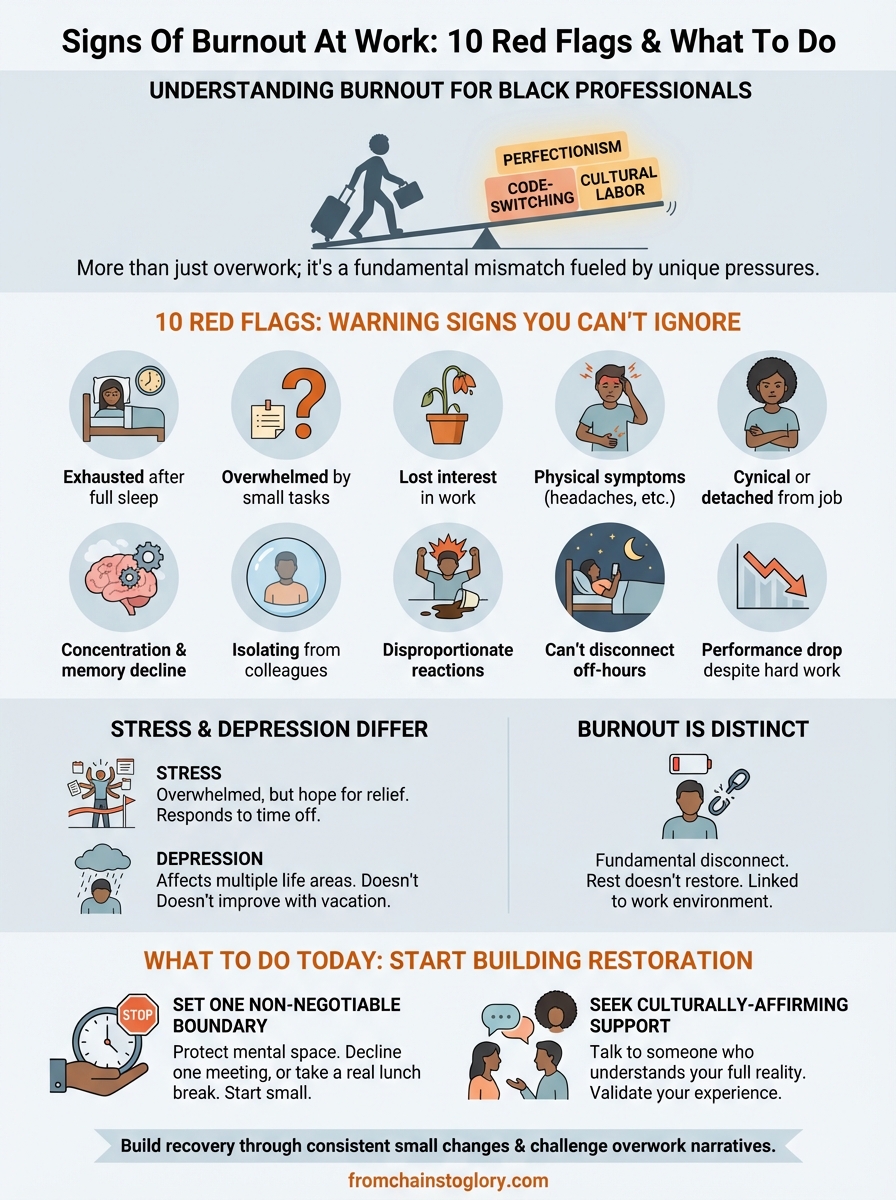
1. You feel exhausted even after sleeping through the night
2. Every task feels overwhelming, no matter how small
3. You’ve lost interest in work that once energized you
4. Physical symptoms appear like headaches, stomach issues, or muscle tension
5. You’re cynical or detached about your job and coworkers
6. Concentration and memory have declined noticeably
7. You isolate yourself from colleagues and avoid social interaction
8. Small frustrations trigger disproportionate reactions
9. You can’t disconnect from work even during off hours
10. Your performance has dropped despite working harder
When three or more of these signs persist for weeks, you’re experiencing burnout, not just a rough patch.
Burnout vs stress and depression
Understanding the difference between burnout, stress, and depression matters because each condition requires its own approach to healing. While these experiences share overlapping symptoms like exhaustion and withdrawal, their origins and solutions diverge significantly. Recognizing which pattern you’re experiencing helps you target your recovery efforts effectively rather than applying generic wellness advice that misses the mark.
How stress differs from burnout
Stress involves feeling overwhelmed by immediate demands, but you can still envision relief once you complete certain tasks or projects. Your body stays in high alert mode, but you maintain hope that finishing your current workload will bring rest. Stress responds to time management, delegation, and temporary boundary setting. Burnout operates differently because no amount of task completion restores your energy or reconnects you to your sense of purpose. The signs of burnout at work persist even after you check items off your list, revealing that the problem runs deeper than workload alone.
Stress says “too much”; burnout says “what’s the point?”
When depression overlaps with burnout
Depression can develop alongside or as a result of prolonged burnout, creating a compounding effect that makes both conditions harder to identify clearly. Depression typically affects multiple life areas beyond work, while burnout remains tied specifically to your professional environment. You might experience depressive symptoms that improve during vacation but return immediately when you resume work, which points toward burnout as the primary driver rather than clinical depression requiring different treatment approaches.
What to do today if you feel burned out
When signs of burnout at work become impossible to ignore, you need immediate relief strategies that address your reality without requiring you to quit your job or overhaul your entire life by tomorrow. Start with actions you can take within the next few hours rather than waiting for conditions to improve on their own. These steps won’t solve burnout completely, but they create breathing room while you develop a longer-term recovery plan.
Set one non-negotiable boundary right now
Choose a single boundary you can enforce today that protects your mental space. This might mean turning off work notifications after a specific hour, declining one meeting that doesn’t require your direct input, or taking your full lunch break away from your desk without checking email. You don’t need permission to protect your basic needs, and implementing one boundary successfully builds momentum for establishing others. Black professionals often face pushback when setting limits because your competence gets weaponized into unlimited availability, but your health matters more than maintaining that unsustainable reputation.
Set one non-negotiable boundary right now

Your excellence doesn’t require your exhaustion.
Talk to someone who understands your full reality
Reach out to a friend, family member, or therapist who gets the cultural context of what you’re carrying. Naming your experience out loud reduces its power and helps you realize you’re not imagining the weight you feel. Avoid people who will minimize your struggles or suggest you’re being too sensitive about workplace dynamics you know are real.
How to recover and prevent burnout while working
Recovery from burnout happens through consistent small changes rather than waiting for perfect conditions that may never arrive. You need strategies that work within your current job while you explore whether staying in that environment serves your long-term wellbeing. Prevention requires addressing both the external pressures you face and your internal responses to those pressures, particularly the perfectionism and proving mindset that accelerates exhaustion.
Build recovery into your daily routine
Micro-breaks throughout your workday matter more than occasional extended rest because they interrupt the stress accumulation cycle before it compounds. Take five minutes every two hours to step away from your screen, stretch, or practice deep breathing. Your brain needs these pauses to process information and reset your nervous system, especially when you’re navigating high-stakes environments that demand constant alertness.
Challenge the narratives driving overwork
Examine the beliefs that keep you pushing past your limits, particularly thoughts like “I have to be twice as good” or “showing weakness will cost me everything.” These protective strategies once helped you survive, but they’re now accelerating the signs of burnout at work you’re experiencing. Replacing them requires conscious practice and often benefits from working with a therapist who understands the cultural context behind your drive.
Your worth exists independent of your productivity.
signs of burnout at work infographic
Next steps
Recognizing the signs of burnout at work gives you power to change your situation before it changes you. You’ve read the red flags, identified what differentiates burnout from stress, and learned immediate strategies to create relief. The question now is whether you’ll continue carrying this weight alone or get support that understands your full reality.
Recovery doesn’t require you to have all the answers today. Start with one boundary, one honest conversation, or one decision to prioritize your wellbeing over proving your worth. Black professionals deserve therapeutic spaces where cultural context isn’t an obstacle to overcome but a foundation for healing.
At From Chains to Glory, we provide Afrocentric therapy designed specifically for high-achieving professionals navigating the unique pressures you face. You don’t need to explain the Black Tax, code-switching, or perfectionism to someone who already gets it. Your restoration matters, and building toward it starts with choosing yourself today.