
Raising children who can think for themselves while keeping your sanity intact, that’s the promise of love and logic parenting. This approach, developed by Jim Fay and Foster Cline, teaches parents to set firm boundaries while allowing children to learn from natural consequences. For Black families navigating the dual pressures of preparing children for a biased world and nurturing their spirits, this philosophy offers practical tools worth examining.
At From Chains to Glory, our family therapy work often centers on moving from survival-based parenting to legacy-building. Many of our clients, high-achieving professionals carrying the weight of being “the strong one”, want to raise confident, capable children without repeating patterns they experienced growing up. Love and Logic provides a framework that respects both parent and child, which aligns with our belief that healing happens when dignity remains intact.
This guide breaks down the core principles, specific techniques you can use today, and real examples of Love and Logic in action. You’ll also find recommended books and courses to deepen your understanding if this approach resonates with your family’s values.
Why Love and Logic works for modern families
Traditional parenting advice often asks you to choose between being too strict or too permissive. Love and logic parenting offers a third path that honors both your authority as a parent and your child’s need to develop independent thinking. This balance matters especially when you’re juggling demanding careers, community expectations, and the reality that your children will face situations where you cannot intervene.
It reduces power struggles before they start
You spend less time arguing when children experience the natural outcomes of their choices. Instead of threatening consequences you may not enforce, you step back and let reality teach the lesson. When your teenager forgets their lunch, they feel hungry at school rather than hearing another lecture about responsibility. This approach frees up your mental energy for meaningful connection instead of constant policing.
Children learn faster from experiences than from our words, especially when those words sound like nagging.
It builds decision-making skills early
Your children face higher stakes as they grow, from navigating biased systems to making choices that affect their safety and future. Love and logic parenting trains them to think through consequences while the decisions are still small. A six-year-old who chooses their outfit and faces peer reactions at school develops judgment they’ll need later when choosing friends, colleges, or career paths. The method gives children controlled practice in decision-making when you’re still there to support them through the aftermath.
Parents who come to From Chains to Glory often recognize this need. They want their children equipped not just to survive but to thrive, and that requires internal guidance systems stronger than external rules.
Core principles of Love and Logic
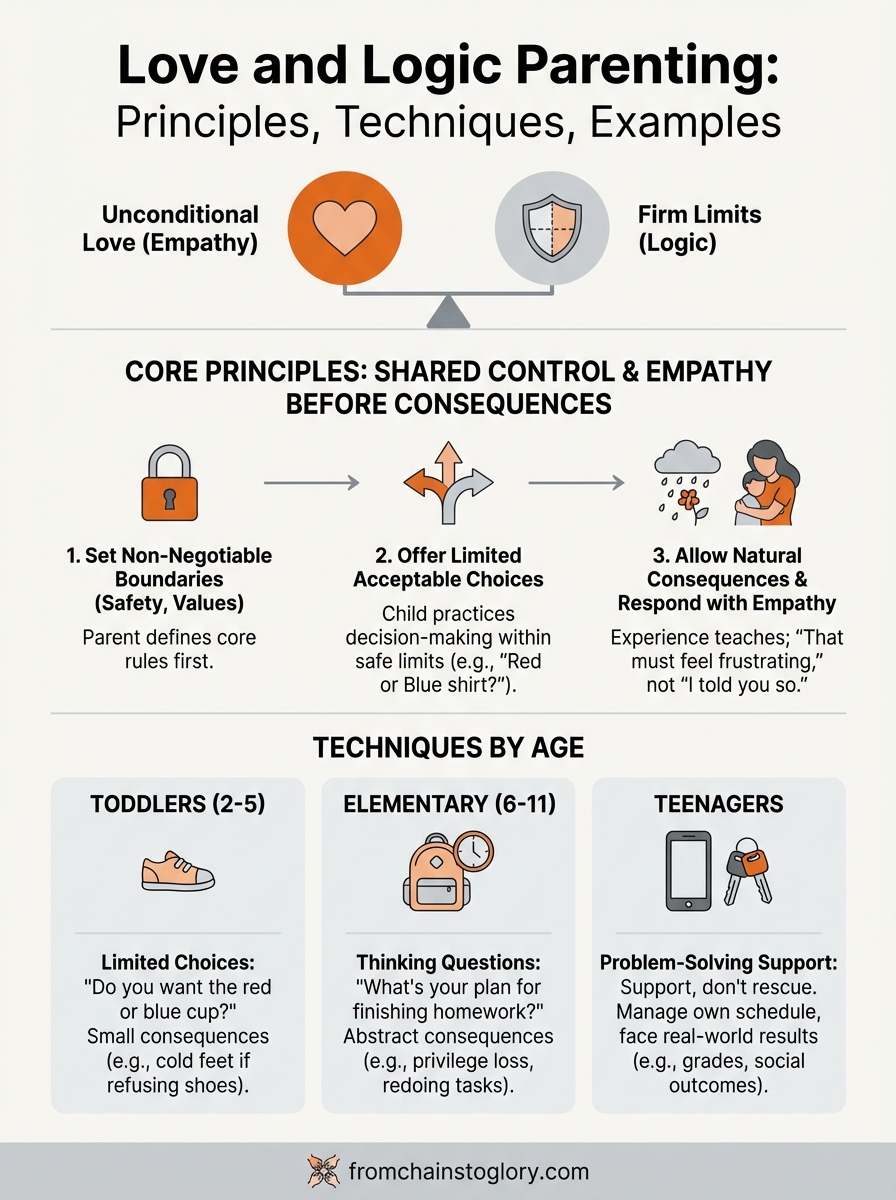
The love and logic parenting approach rests on two equal pillars: unconditional love combined with firm limits. You give your child freedom to make choices within boundaries you set, then respond with empathy when those choices lead to uncomfortable results. This structure creates psychological safety while building competence, which matters when you’re raising children who need both roots and wings.

Shared control
You cannot control everything your child does, and attempting to creates exhaustion for you and rebellion in them. Love and Logic asks you to identify areas where you hold non-negotiable authority (safety, health, values) and areas where your child can practice decision-making (clothing, hobbies, spending their allowance). When you stop fighting over small choices, your child invests more cooperation in the areas that truly matter. This principle acknowledges that control is finite, so you spend it wisely.
Children who feel powerless in small decisions often fight harder for control in dangerous ways.
Empathy before consequences
Your tone matters as much as the boundary. When your child faces the natural result of their choice, you respond with genuine compassion rather than “I told you so.” This empathy makes the consequence itself the teacher, not your anger. Your child learns from the situation instead of focusing on defending against your disappointment.
Techniques you can use at every age
Love and logic parenting adapts to your child’s developmental stage while maintaining consistent principles. The techniques shift based on your child’s cognitive abilities and independence level, but the foundation stays the same: you offer choices within limits, allow natural consequences to teach, and respond with empathy instead of anger. What works for a toddler learning to dress themselves differs from approaches for a teenager managing their social calendar.
Toddlers and preschoolers (ages 2-5)
You give limited choices between two acceptable options: “Do you want the red shirt or the blue shirt?” rather than “What do you want to wear?” This builds their decision-making muscles without overwhelming them. When your three-year-old refuses to put on shoes, you calmly carry the shoes and let them experience cold feet outside. Your tone stays neutral, not triumphant, because the discomfort itself delivers the message.
Small children learn through repetition and sensory experience, not through lectures about future problems.
Elementary years (ages 6-11)
Your child can handle bigger choices now, like how they spend their allowance or organize their homework time. Natural consequences become more abstract: they lose privileges when screen time rules break, or they redo chores done carelessly. You ask thinking questions instead of giving answers: “What’s your plan for finishing that project?” This age group responds well when you acknowledge their growing capability.
Teenagers
You step further back while maintaining non-negotiable boundaries around safety and values. Your teen manages their own schedule, social life, and academic workload while experiencing real-world results of their planning. When they fail, you offer empathy and problem-solving support rather than rescue.
How to parent with Love and Logic step by step
Implementing love and logic parenting requires intentional preparation rather than reactive responses in heated moments. You establish your framework before conflicts arise, which means thinking through your non-negotiable boundaries and acceptable choice areas ahead of time. This upfront work prevents you from making decisions when emotions run high and your child tests limits. The process becomes more natural with practice, though you’ll refine your approach as you learn which consequences actually teach versus which ones create unnecessary suffering.

Set your boundaries first
You identify what matters most to your family before situations demand immediate decisions. Write down your core values around safety, respect, health, and education. These become your non-negotiable areas where your child has no choice. Everything else becomes potential decision-making territory for your child. This clarity helps you respond consistently instead of changing rules based on your mood or stress level.
Clear boundaries give children the security to explore freely within safe limits.
Offer choices within those limits
You present two acceptable options that you can live with either way. Your five-year-old chooses between breakfast items you’ve already approved. Your teenager picks their weekend curfew between times you’ve pre-determined. Both choices lead to outcomes you accept, which removes power struggles while building their decision-making confidence.
Step back when consequences arrive
You allow natural results to teach the lesson while you respond with genuine empathy. Your child forgot their homework, so they face the teacher’s consequence while you say, “That must feel frustrating.” You resist the urge to rescue or lecture because the experience itself provides the most powerful learning opportunity.
Examples and scripts for common situations
Seeing love and logic parenting in action helps you adapt the language to your family’s specific challenges. The scripts below show how you communicate boundaries with empathy while letting consequences do the teaching. You’ll notice the tone stays calm and the focus shifts from controlling behavior to supporting learning. These examples work across different ages when you adjust the choices and consequences to match your child’s developmental level.
Morning routine battles
Your child refuses to get dressed for school, and you need to leave in ten minutes. You offer a choice: “Do you want to get dressed here or bring your clothes in the car?” Your tone stays neutral, not threatening. When they choose neither option, you calmly say, “I see you’re choosing to go in pajamas. That must feel embarrassing when we get to school.” You follow through without anger because the social consequence teaches better than your frustration.
Natural consequences work best when you respond with genuine empathy rather than satisfaction at being right.
Homework resistance
Your child procrastinates on their project until the night before it’s due. Instead of staying up late helping them finish, you say, “That sounds stressful. What’s your plan?” When they ask you to help at midnight, you respond with compassionate limits: “I understand you’re worried. I’m available until 9 p.m. on school nights. Tomorrow you’ll figure out what to tell your teacher.” The grade teaches the planning lesson you cannot.
love and logic parenting infographic
Key takeaways and next steps
Love and logic parenting gives you a framework that respects both your authority and your child’s need to develop independence. You set firm boundaries around what matters most, offer choices within those limits, and let natural consequences teach lessons while you respond with genuine empathy. This approach reduces power struggles and builds the decision-making skills your children need to navigate a world that won’t always protect them.
The techniques work when you prepare ahead of time rather than react in heated moments. You identify your non-negotiable values first, then create space for your child to practice choices in safer areas. Your consistency matters more than perfection because children test boundaries to confirm they can trust your word.
If you’re ready to move from survival-based parenting to legacy-building while honoring your family’s cultural identity, our Afrocentric family therapy supports you in creating patterns that break generational cycles. You don’t have to translate your experiences or explain your concerns when working with someone who already understands.