
You’ve earned your seat at the table. The degrees, the promotions, the respect, it’s all there. But so is the exhaustion that nobody sees. Learning how to manage stress at work isn’t just about breathing exercises or taking lunch breaks. For Black professionals, it means navigating spaces that weren’t designed with you in mind while carrying the weight of representing an entire community.
The pressure to perform flawlessly, code-switch on demand, and absorb microaggressions without missing a beat takes a toll that generic wellness advice simply doesn’t address. You’re not just managing deadlines, you’re managing a double consciousness that follows you from the parking lot to the conference room and back home again.
At From Chains to Glory, we understand that your stress has layers. That’s why this guide offers practical tools rooted in the realities you actually face. You’ll find strategies that honor your experience, protect your energy, and help you reclaim peace without sacrificing your ambition. Because thriving at work shouldn’t require losing yourself in the process.
What work stress looks like for Black professionals
Your stress doesn’t announce itself with a memo. It shows up in the hypervigilance you feel walking into meetings where you’re the only one. It lives in the mental calculations you make before speaking, the internal editor that runs constantly to ensure your tone, volume, and word choice can’t be weaponized against you. This particular brand of workplace stress compounds daily because it operates on multiple levels simultaneously.
What work stress looks like for Black professionals

The invisible labor you carry
Beyond your job description, you shoulder responsibilities that never appear in your performance review. You translate cultural context for colleagues who don’t understand why certain comments land differently. You become the unofficial spokesperson for an entire race when current events make headlines. Your inbox fills with requests to join diversity committees, review inclusion statements, and educate others on topics they could research themselves. This unpaid emotional labor drains your capacity while others assume you’re simply engaged and passionate about the work.
The toll isn’t just mental. Your body keeps score through tension headaches, disrupted sleep, and the exhaustion that lingers no matter how much you rest.
When “professionalism” means code-switching
Learning how to manage stress at work becomes exponentially harder when authenticity feels risky. You monitor your natural speech patterns, swap out expressions that might read as “too urban,” and adjust your demeanor to appear approachable but not too casual. The cognitive load of this constant switching creates fatigue that compounds throughout your workday. Some days you leave the office having said nothing wrong but feeling completely drained from the performance required just to be perceived as competent and non-threatening.
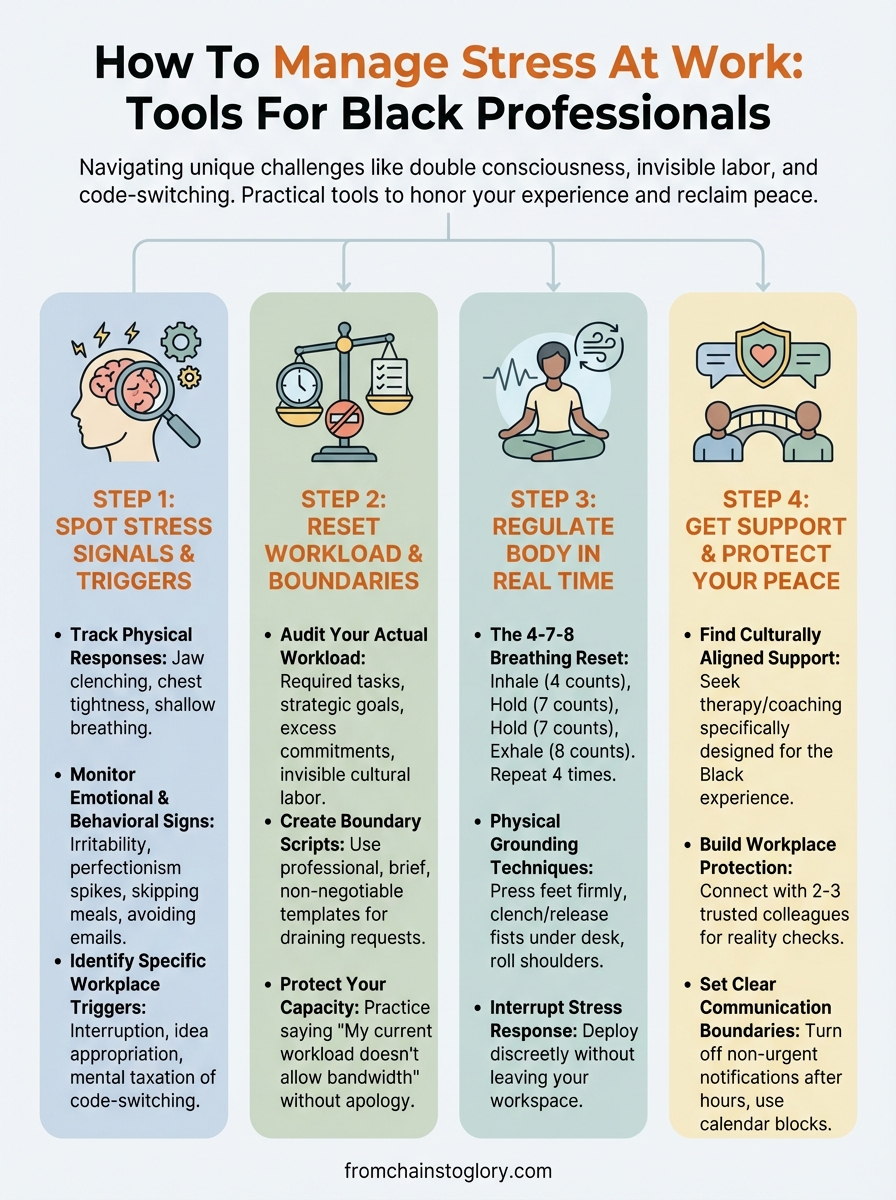
Step 1. Spot your stress signals and triggers
You can’t manage stress you haven’t identified. Learning how to manage stress at work starts with recognizing your body’s warning system before you hit the breaking point. Your stress signals show up in patterns, physical responses that repeat when pressure builds. These signals might include jaw clenching during meetings, chest tightness before presentations, or sudden irritability when interrupted. Track these responses for one week to establish your baseline.
Document your stress responses
Create a simple log to track when stress surfaces. Note the time of day, what you were doing, and how your body responded. You’ll start seeing patterns emerge, maybe Sunday evenings trigger anxiety about Monday meetings, or certain colleagues consistently leave you exhausted.
Common stress signals to track:
- Physical: headaches, tight shoulders, stomach issues, shallow breathing
- Emotional: irritability, withdrawal, perfectionism spikes, decision fatigue
- Behavioral: skipping meals, overworking, avoiding emails, difficulty sleeping
Identify your specific workplace triggers
Your triggers differ from others because your experience differs. Scan your recent work weeks for moments when stress spiked. Was it being interrupted repeatedly? Sitting in meetings where your ideas get credited to others? The mental taxation of code-switching before client calls? Name these triggers specifically instead of labeling everything as “just stressful.”
Understanding your unique stress patterns gives you a map to navigate workplace pressure before it becomes crisis.
Step 2. Reset your workload and boundaries
You can’t pour from an empty cup, and trying to do everything perfectly is draining yours. Learning how to manage stress at work requires honest evaluation of what’s actually on your plate versus what realistically fits within your working hours. Most Black professionals carry invisible workload items that bloat their responsibilities without recognition or compensation. This step involves a strategic reset where you reclaim control over your time and energy.
Audit your actual workload
List every task and commitment you handle in a typical work week. Include formal assignments, diversity initiatives, mentoring requests, and informal labor like cultural translation. Assign each item a category: required by your role, beneficial to your career, or drain without return. This visual inventory reveals where your energy actually goes versus where your job description says it should go.
Use this workload assessment:
- Required: tasks tied directly to performance metrics
- Strategic: activities advancing your stated career goals
- Excess: commitments outside your role with no clear benefit
- Invisible: cultural labor and education you provide unpaid
Create boundary scripts
Boundaries protect your capacity without requiring lengthy explanations. Draft three response templates for common requests that typically drain you. Keep them professional, brief, and non-negotiable. Practice saying “My current workload doesn’t allow bandwidth for additional projects” without apologizing or over-explaining your decision.
Clear boundaries aren’t selfish protection, they’re strategic preservation of the energy you need to excel where it actually counts.
Step 3. Regulate your body in real time
Your body responds to workplace stress instantly, and waiting until you get home to address it lets tension compound throughout your day. Learning how to manage stress at work means developing physical regulation techniques you can deploy without leaving your desk or drawing attention. These tools interrupt your stress response in the moment, preventing small pressures from escalating into overwhelm that affects your judgment and performance.
The 4-7-8 breathing reset
Your breath is the fastest route to calming your nervous system. Use this discreet breathing pattern when stress surfaces: inhale quietly through your nose for 4 counts, hold for 7 counts, exhale completely through your mouth for 8 counts. Complete this cycle four times while sitting at your desk or before entering a tense meeting. This technique activates your parasympathetic nervous system, signaling safety to your body even when your environment feels threatening.
Physical grounding techniques
When anxiety spikes, ground yourself through intentional movement. Press your feet firmly into the floor and notice the contact points. Clench and release your fists three times under your desk. Roll your shoulders backward five times. These micro-movements discharge stored tension without requiring you to step away from your workspace.
Physical regulation isn’t about eliminating stress, it’s about preventing stress from controlling your body’s reactions.
Step 4. Get support and protect your peace at work
Isolation multiplies workplace stress, especially when you’re navigating challenges your colleagues don’t recognize or understand. Knowing how to manage stress at work includes identifying who can actually support you without requiring you to educate them first. This step involves building a strategic support network while establishing protective barriers around your mental space during work hours.
Find culturally aligned support
Traditional Employee Assistance Programs rarely address the specific stressors you face as a Black professional. Seek therapy or coaching specifically designed for the Black experience, where you won’t spend sessions explaining microaggressions or why certain interactions drain you differently. Look for professionals who understand the cultural taxation of navigating predominantly white workspaces and can offer strategies rooted in that reality rather than generic stress management advice.
Build your workplace protection strategy
Identify two to three trusted colleagues who understand the layered nature of your experience. These connections provide reality checks when you question whether a situation crossed the line or you’re overreacting. Set clear communication boundaries by turning off non-urgent notifications after hours, using calendar blocks to protect focus time, and establishing response time expectations that preserve your capacity.
Protecting your peace isn’t about avoiding all workplace stress, it’s about choosing which battles deserve your energy.
how to manage stress at work infographic
Next steps to keep your peace
You now have practical tools to shift how to manage stress at work without waiting for your workplace to change first. These strategies work because they address the specific pressures you face as a Black professional, the cultural taxation and invisible labor that compound standard workplace stress. Implementation matters more than perfection. Start with one technique from each step and build your practice over weeks, not days.
Sustainable peace requires more than individual coping strategies. Working with a therapist who understands your cultural experience eliminates the exhausting work of explaining why certain workplace dynamics drain you differently. At From Chains to Glory, we provide Afrocentric therapy for Black professionals navigating high-pressure environments where authenticity feels risky. Our approach integrates your cultural heritage with evidence-based techniques, creating space where you don’t code-switch to heal. Your strength got you this far. Strategic support helps you stay there without sacrificing your peace.