
You’ve earned degrees, built a career, and become the person everyone leans on. Yet when you’re alone with your thoughts, that inner voice still whispers that you’re not enough, or that one wrong move will expose you as a fraud. If you’re searching for how to improve self esteem, you’re not looking for generic affirmations that ignore what it actually costs to show up as a Black professional in spaces that weren’t designed for you.
Low self-esteem doesn’t always look like shrinking. Sometimes it looks like overworking to prove your worth, staying silent when you deserve credit, or carrying the weight of being the “strong one” while quietly falling apart. The pressure to be twice as good, the exhaustion of code-switching, and the generational patterns you inherited all shape how you see yourself.
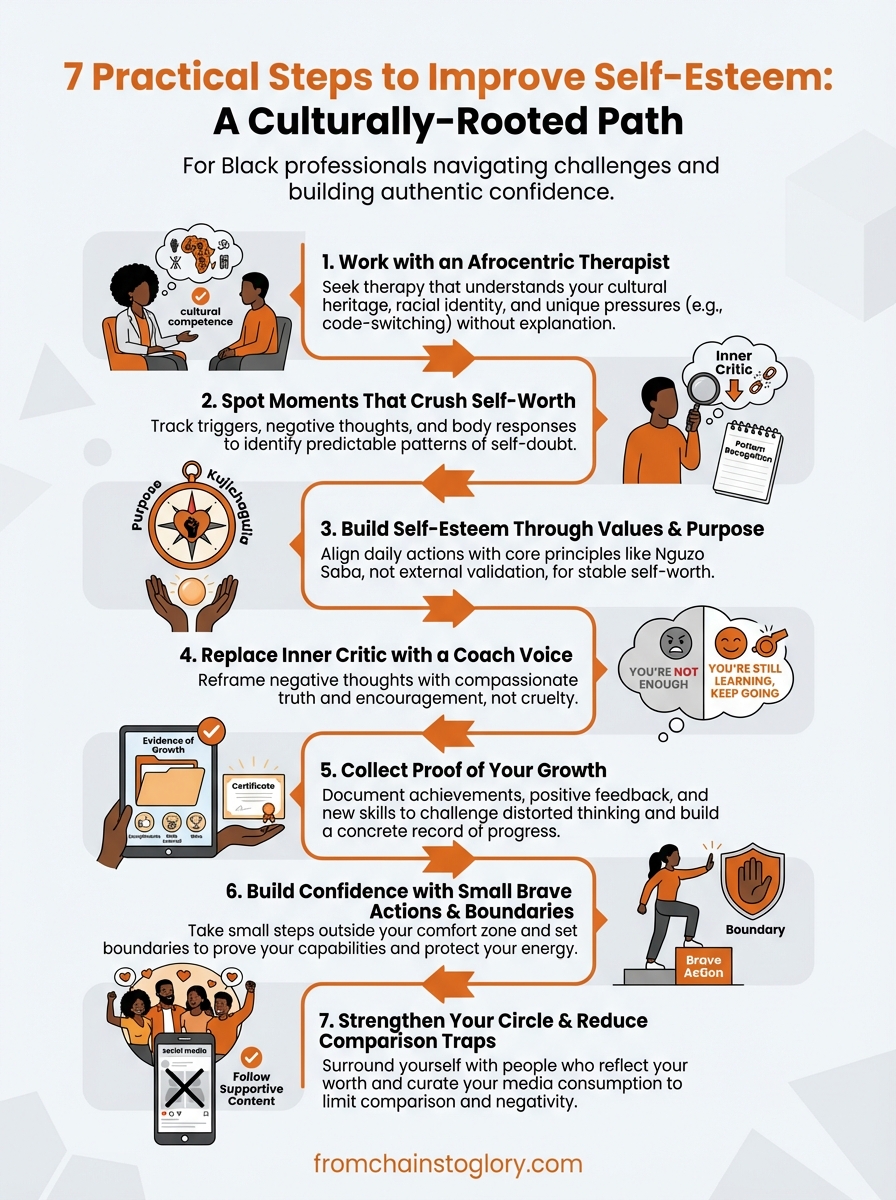
At From Chains to Glory, we understand that building authentic confidence requires more than surface-level tips, it demands cultural alignment and healing rooted in who you actually are. That’s why the strategies below go beyond standard advice. These seven practical steps draw from both evidence-based psychology and the resilience embedded in our community’s history, giving you a path from self-doubt to unshakeable self-worth.
1. Work with an Afrocentric therapist who gets it

When you’re figuring out how to improve self esteem, the therapist you choose matters as much as the decision to seek help itself. An Afrocentric therapist brings cultural competence from day one, which means you won’t spend your sessions explaining why microaggressions hurt or why your grandmother’s advice still shapes how you move through the world. You can walk in and be fully seen without translating your experience into language that centers someone else’s reality.
What this step looks like
Afrocentric therapy creates a space where your racial identity and cultural heritage inform the healing process instead of being treated as side notes. Your therapist understands the Black Tax without you having to define it, recognizes the weight of respectability politics, and acknowledges generational trauma as real context for your current struggles. Sessions feel less like clinical diagnosis and more like reclaiming power with someone who speaks your language and honors where you come from.
Why it works
Traditional therapy models often pathologize Black experiences or ignore the systemic pressures that erode self-worth. When your therapist already understands code-switching exhaustion and the specific ways racism attacks confidence, you spend less time teaching and more time healing. This cultural alignment accelerates progress because you’re not fighting to be understood, you’re working with someone who gets it and can help you build confidence rooted in your actual identity, not a watered-down version of yourself.
You deserve a therapist who treats your culture as strength, not a complication to work around.
How to do it in 10 minutes
Start by identifying therapists who explicitly mention Afrocentric frameworks or culturally responsive care for Black clients in their profiles. Look for mentions of concepts like the Nguzo Saba, racial trauma work, or community healing models. Schedule a brief consultation call to ask how they integrate cultural identity into treatment and whether they understand the unique pressures you face as a high-achieving Black professional.
When to get extra help
If your current therapist requires you to explain basic cultural experiences or dismisses race-related stress as secondary to other issues, that’s your sign to find someone else. When self-doubt keeps you from applying for promotions, strains your relationships, or leaves you feeling like an imposter despite your achievements, working with an Afrocentric therapist becomes essential, not optional.
2. Spot the moments that crush your self-worth
When you want to know how to improve self esteem, you first need to recognize the specific situations that drain it. Your confidence doesn’t evaporate randomly. It gets chipped away in predictable patterns that you can learn to identify and interrupt before they spiral.
What this step looks like
Awareness starts by tracking the exact moments when your inner critic takes over or when you feel yourself shrinking. You notice when a comment from a colleague triggers doubt about your competence, when scrolling social media leaves you feeling inadequate, or when family gatherings remind you of old wounds that still sting. This step involves naming the trigger, the thought it creates, and how your body responds.
Why it works
You can’t change patterns you don’t see. When you identify your specific self-worth triggers, you stop treating low self-esteem as a constant state and start seeing it as a response to particular situations. This awareness gives you decision points where you can choose a different reaction instead of automatically believing the negative story your mind tells.
Recognition breaks the automatic loop between trigger and self-doubt.
How to do it in 10 minutes
Keep a simple note on your phone for one week. Each time you feel a confidence drop, jot down what just happened, what thought followed, and where you felt it in your body. After seven days, review your notes to find the common threads.
When to get extra help
If your triggers happen constantly or if awareness alone doesn’t reduce their impact, working with a therapist helps you understand the deeper roots and develop stronger responses.
3. Build self-esteem through values and purpose
When you’re learning how to improve self esteem, connecting to your deeper values provides an anchor that external validation can never give you. Your confidence becomes less fragile when it rests on living your purpose instead of chasing approval from systems that weren’t built to recognize your worth.
What this step looks like
Values-based living means making daily decisions guided by what actually matters to you, not what the world demands. You identify the core principles that reflect who you are at your best, whether that’s rooted in the Nguzo Saba like Kujichagulia (self-determination) and Nia (purpose), or personal commitments to family, creativity, or justice. Your self-worth stops depending on performance metrics and starts connecting to whether you’re honoring what you believe in.
Why it works
Self-esteem built on external achievements crumbles when you face setbacks or when the goalposts shift. When your confidence flows from alignment with your values, you measure success differently. A day spent mentoring someone or setting a boundary becomes as meaningful as landing a promotion because both reflect purposeful living rather than proving yourself to others.
Your worth isn’t determined by how well you perform in someone else’s game.
How to do it in 10 minutes
Write down three moments this week when you felt proud, not because of external praise but because your actions matched your personal values. Identify the principle behind each moment and commit to one small action tomorrow that honors that same value.
When to get extra help
If you struggle to identify any values beyond productivity or feel like you’ve lost connection to what matters beyond survival, therapy helps you reconnect to purpose beneath the pressure.
4. Replace your inner critic with a coach voice
The voice that tells you you’re not enough often sounds louder than reality. When you’re learning how to improve self esteem, one of the most powerful shifts involves recognizing that internal dialogue and intentionally changing its tone from harsh critic to supportive coach.
What this step looks like
Replacing your inner critic means catching the automatic negative thoughts and deliberately reframing them with compassionate truth. Instead of “I’m terrible at this,” your coach voice says “I’m still learning this skill.” When you make a mistake, the critic screams that you’ve proven everyone’s doubts right, but your coach voice reminds you that one error doesn’t define your competence. This practice requires you to notice the difference between accountability and cruelty in how you talk to yourself.
Why it works
Your brain treats internal criticism as fact unless you challenge it. When you speak to yourself with the same respect and encouragement you’d offer someone you’re mentoring, you create space for growth instead of shame. This shift doesn’t ignore real mistakes, it addresses them without destroying your sense of worth in the process.
Self-compassion builds resilience that self-criticism never could.
How to do it in 10 minutes
Write down three harsh things your inner critic said this week. Below each one, write what a supportive coach who believes in you would say instead, using specific evidence from your actual life.
When to get extra help
If your inner critic’s voice feels impossible to quiet or if it echoes specific trauma from your past, therapy provides tools to separate old wounds from present reality.
5. Collect proof that you are growing
Your brain naturally focuses on what went wrong while ignoring evidence of progress. When you’re figuring out how to improve self esteem, actively documenting your growth creates a concrete record that challenges the distorted story your inner critic tells about your worth and capabilities.
What this step looks like
Collecting proof means creating a physical or digital file where you save evidence of your progress. You screenshot kind messages from colleagues, save thank-you notes from people you’ve helped, document skills you’ve learned, and record moments when you handled something better than you would have six months ago. This evidence collection becomes your personal archive that proves growth is happening even when self-doubt tries to convince you otherwise.
Why it works
Self-doubt thrives when your mind selectively remembers failures while discounting wins. When you build an evidence file, you create objective proof that contradicts negative beliefs about yourself. Looking at accumulated evidence shifts your perspective from “I never do anything right” to “Here are twelve specific examples showing I’m capable and making progress.”
Your growth becomes undeniable when you have proof you can actually see and touch.
How to do it in 10 minutes
Create a folder on your phone or computer labeled “Evidence of Growth.” Add three things right now: a compliment you received recently, a challenge you overcame this month, and one skill you have today that you didn’t have last year.
When to get extra help
If collecting evidence feels impossible because you genuinely cannot identify any wins or if you dismiss every achievement as luck rather than capability, therapy helps you recognize the distorted thinking patterns that keep you stuck.
6. Build confidence with small brave actions and boundaries

Real confidence grows through action, not affirmations. When you’re learning how to improve self esteem, taking small brave steps and protecting your energy through boundaries creates tangible proof that you can trust yourself. Each time you do something that scares you or say no when you need to, you deposit evidence into your self-worth account that no one can take away.
6. Build confidence with small brave actions and boundaries
What this step looks like
Small brave actions mean doing things slightly outside your comfort zone while boundaries involve protecting your time and energy. You speak up in a meeting when normally you’d stay quiet, you decline an extra project when your plate is already full, or you have an honest conversation instead of pretending everything is fine. These micro-acts of courage stack up and reshape how you see yourself because they prove you can handle discomfort.
Why it works
Confidence isn’t built by thinking differently, it’s built by acting differently and seeing that you survive. Each boundary you set teaches you that your needs matter, while each brave action proves you’re more capable than fear claims. This process creates a feedback loop where action builds confidence and confidence makes the next action easier.
You become who you practice being through your daily choices.
How to do it in 10 minutes
Pick one small brave action for tomorrow, something that makes you slightly uncomfortable but won’t destroy your life if it goes wrong. Write down one boundary you’ll set this week and what you’ll say when you enforce it.
When to get extra help
If taking any action feels paralyzing or if you cannot set boundaries without intense guilt, therapy helps you understand what’s blocking you and build practical skills to move forward.
7. Strengthen your circle and reduce comparison traps
The people you spend time with and the content you consume directly shape your self-perception. When you’re learning how to improve self esteem, curating your environment matters as much as changing your thoughts because constant comparison and unsupportive relationships silently erode confidence while you’re not paying attention.
What this step looks like
Strengthening your circle means choosing relationships that reflect your worth back to you accurately. You spend more time with people who celebrate your wins without competing, who tell you the truth with love instead of judgment, and who understand the specific pressures you carry. Reducing comparison traps involves setting boundaries with social media consumption, unfollowing accounts that trigger inadequacy, and limiting time with people who make you feel small.
Why it works
Your brain absorbs messages from your environment whether you consciously notice or not. When you surround yourself with people who see your value and reduce exposure to curated highlight reels that distort reality, you stop measuring yourself against impossible standards.
You cannot build authentic confidence while constantly consuming content designed to make you feel insufficient.
How to do it in 10 minutes
Identify one relationship that consistently drains your self-worth and one that builds it. Commit to spending less time with the draining person and more with the supportive one. Unfollow three accounts that trigger comparison.
When to get extra help
If you feel isolated with no supportive relationships or if comparison thoughts consume hours of your day, therapy helps you build connection skills and challenge distorted thinking.
how to improve self esteem infographic
Your next small step
You now have seven practical strategies for how to improve self esteem that go beyond surface-level advice. These steps work because they address the real challenges you face as someone who navigates spaces that weren’t designed for you while carrying the weight of being the strong one everyone depends on.
Pick one step that resonates most right now. You don’t need to master all seven tomorrow. Sustainable change happens when you build momentum through small consistent actions rather than trying to overhaul everything at once. Maybe you start by spotting your triggers this week, or perhaps you create your evidence file today. Each small step compounds into lasting confidence when you give yourself permission to grow at your own pace.
If you’re ready to work with someone who understands these challenges without explanation, From Chains to Glory offers Afrocentric therapy designed specifically for high-achieving Black professionals. You deserve support that honors your cultural identity while helping you build the unshakeable self-worth you’ve been searching for.