
You’ve earned your seat at the table. You’ve done the work, put in the hours, and proven yourself ten times over. But when it comes to speaking up for what you need, whether it’s a boundary at work, a difficult conversation with your partner, or a request within your family, something holds you back. Maybe it’s the fear of being labeled “too much” or “aggressive.” Maybe it’s years of being conditioned to keep the peace at your own expense.
Assertive communication skills offer a path forward, one where you can express your needs clearly and confidently without sacrificing your relationships or your reputation. This isn’t about being loud or demanding. It’s about honoring your voice while respecting others.
At From Chains to Glory, we work with high-achieving Black professionals and families who carry the weight of always being “on.” We see how communication patterns shape mental health, and how reclaiming your voice is an act of self-determination. For our community, learning to speak up assertively isn’t a soft skill. It’s self-preservation.
This guide breaks down what assertive communication actually means, why it matters for your relationships and peace of mind, and practical techniques you can use starting today. Whether you’re navigating workplace dynamics, strengthening your partnership, or breaking generational patterns in your family, these skills will serve you well.
What assertive communication skills mean
Assertive communication skills are your ability to express your thoughts, feelings, and needs directly while respecting the rights and boundaries of others. This communication style sits between passive communication, where you suppress your needs, and aggressive communication, where you prioritize your needs at someone else’s expense. When you communicate assertively, you claim your right to be heard without apology or hostility.
Assertive communication is about standing firm in your truth while leaving room for someone else to stand in theirs.
What assertiveness is not
Many people confuse assertiveness with aggression, especially when Black professionals speak up and face immediate pushback or labeling. Assertive communication doesn’t involve raising your voice, making demands, or dismissing what others think. You’re not trying to win or dominate. You’re simply stating what you need and opening space for conversation. Passive communication, on the other hand, leads you to avoid conflict entirely, often saying yes when you mean no, or staying silent when something bothers you. This might keep temporary peace, but it erodes your well-being over time.
The core of assertive expression
Assertiveness rests on three foundational beliefs: you have a right to your feelings, you deserve to be treated with respect, and you can advocate for yourself without guilt. When you practice this style, you use clear language that names what you observe, how you feel, and what you need. For example, instead of saying “You never listen to me,” an assertive approach would be “I feel unheard when I’m interrupted. I need a chance to finish my thoughts.” This keeps the focus on your experience rather than attacking the other person. You own your perspective without making the other person wrong. This shift changes everything, especially in relationships where historical patterns of silencing or overcompensation have shaped how you show up.
Why assertiveness lowers stress and conflict
When you hold back what you need to say, your body keeps the score. Suppressing your thoughts and feelings doesn’t make them disappear. Instead, they build pressure inside you, showing up as tension in your shoulders, sleepless nights, or sudden outbursts over small things. Assertive communication skills give you a release valve that protects your mental health and strengthens your relationships.
How suppression creates stress
Unspoken needs become resentment, and resentment poisons everything it touches. When you stay silent about what bothers you, your mind rehearses conversations you never have, replays moments where you should have spoken up, and creates anxiety about future interactions. This mental loop exhausts you. Your body releases stress hormones as if you’re under constant threat because, in a way, you are. You’re living in conflict with yourself, which is more draining than any external confrontation.
When you stop carrying what you need to say, your nervous system finally gets to rest.
Why clarity prevents conflict
Assertiveness removes guesswork from your relationships. When you clearly express what you need, others don’t have to read your mind or interpret your silence. This prevents misunderstandings that spark unnecessary arguments. People respect directness, especially when it’s delivered with respect. Your partner, colleagues, and family members can respond to what you actually say rather than what they assume you mean. Clear boundaries also keep small irritations from becoming major blow-ups because you address issues early.
The 3 Cs and other core elements
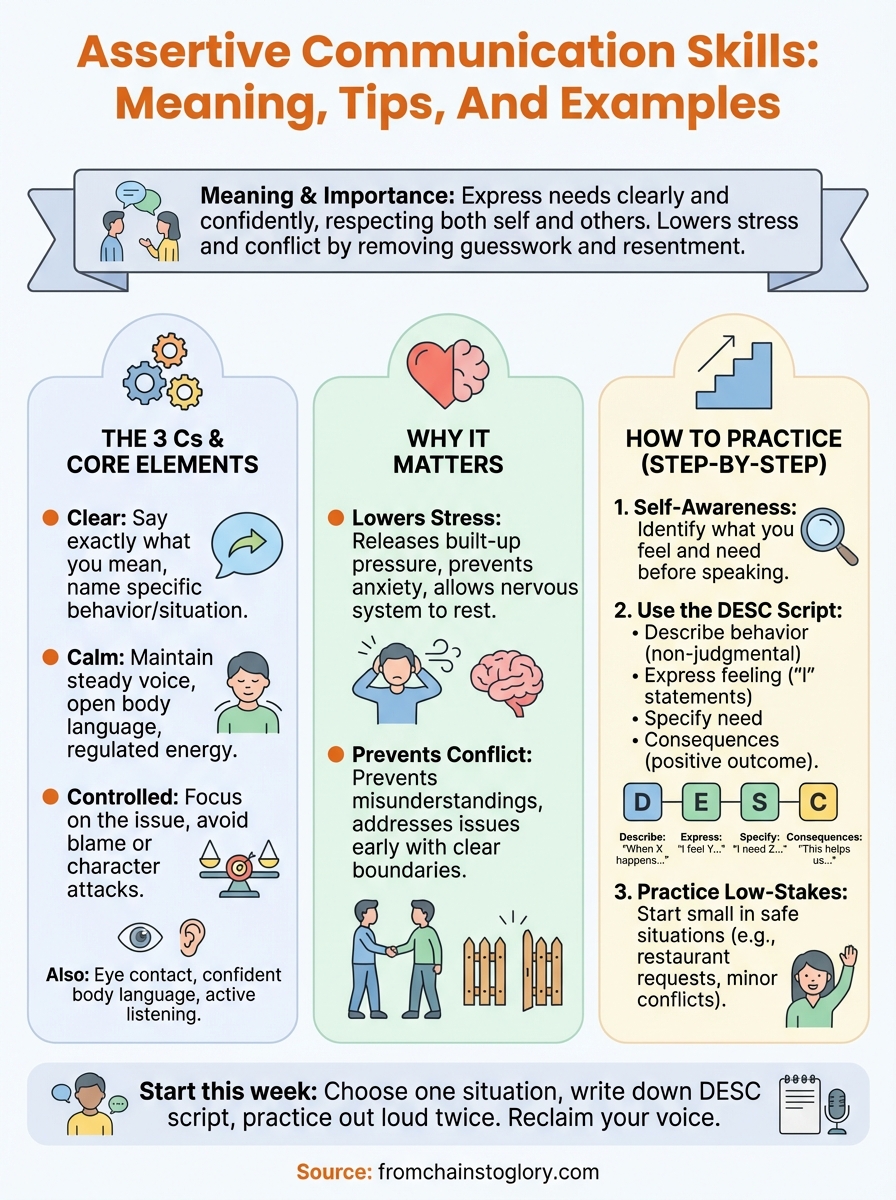
Assertive communication skills rest on a framework called the 3 Cs: Clear, Calm, and Controlled. These three elements work together to help you deliver your message in a way that others can actually receive. When you master these basics, your communication becomes more effective without feeling rehearsed or artificial. You’re not reading from a script. You’re speaking from a grounded place that respects both yourself and the person you’re addressing.

What the 3 Cs stand for
Clear means you say exactly what you mean without beating around the bush or softening your message into meaninglessness. You name the specific behavior or situation that concerns you and state your need directly. Calm refers to your emotional state and tone. You keep your voice steady, your body language open, and your energy regulated even when the topic is difficult. This doesn’t mean you suppress emotion. It means you channel it productively. Controlled means you stay focused on the issue at hand without veering into blame, past grievances, or character attacks. You maintain your composure and stick to what you can influence.
The 3 Cs keep you anchored when conversations get tense.
Additional elements that matter
Beyond the 3 Cs, effective assertiveness requires eye contact, confident body language, and active listening. You can’t truly communicate assertively if you’re looking at the floor or crossing your arms defensively. Your nonverbal cues either support or undermine your words. Active listening also matters because assertiveness creates dialogue, not monologue. You speak your truth, and you make space for the other person’s response.
How to practice assertive communication step by step
Building assertive communication skills takes practice, not perfection. You won’t wake up tomorrow and suddenly speak with complete confidence in every situation. Instead, you develop this ability gradually through deliberate steps that strengthen your capacity to express yourself clearly. The process below gives you a practical roadmap that works whether you’re just starting or you’re ready to refine your approach.
Start with self-awareness
Before you can communicate assertively with others, you need to identify what you actually need. Many people skip this step and wonder why their assertiveness feels forced or ineffective. Take time to notice when you feel frustrated, dismissed, or uncomfortable. What triggered that feeling? What would need to change for you to feel better? You can’t advocate for something if you haven’t named it for yourself first. This self-check might take thirty seconds or thirty minutes, depending on how disconnected you’ve become from your own needs.
Clarity within yourself creates clarity in your communication.
Use the DESC script
The DESC method gives you a step-by-step framework for difficult conversations. Describe the specific behavior or situation you observed without judgment. Express how it affects you using “I” statements. Specify what you need going forward. Consequences follow naturally, either positive outcomes if your need is met or what you’ll do if it isn’t. For example: “When meetings start without me (Describe), I feel disrespected and excluded from decisions (Express). I need to be notified of schedule changes at least an hour ahead (Specify). This helps me contribute fully and stay engaged with the team (Consequences).” This structure keeps you focused and prevents emotional spirals.
Use the DESC script

Practice in low-stakes situations
Don’t test your assertiveness skills during a high-pressure performance review or a heated argument with your partner. Start small. Ask for a different table at a restaurant, return an item that doesn’t fit, or speak up in a meeting about a minor scheduling conflict. These situations give you safe repetitions that build confidence without major consequences if you stumble. Your brain needs proof that assertiveness doesn’t destroy relationships or get you punished before it will let you use these skills when the stakes are higher.
Examples you can use at work and at home
Real-world application separates understanding from action. You can study assertive communication skills all day, but they only matter when you apply them in actual situations that test your confidence. The scenarios below show you how to adapt your approach based on context while maintaining the same core principles of clarity, respect, and directness.
At work
When a colleague repeatedly interrupts you during meetings, try: “I wasn’t finished with my point. I need you to let me complete my thoughts before responding.” This names the behavior and states your boundary without attacking their character. If your manager assigns extra work without adjusting deadlines, you might say: “I want to deliver quality results on both projects. Can we prioritize which one needs completion first, or extend the timeline on one of them?” This approach shows commitment while advocating for realistic expectations.
Your workplace voice matters just as much as your credentials.
At home
If your partner makes plans without checking with you, assertiveness sounds like: “When decisions get made without my input, I feel sidelined. I need us to discuss schedule changes together before confirming them.” With family members who offer unsolicited advice about parenting, you could respond: “I appreciate your concern. Right now, I need support for the decisions I’ve made rather than suggestions for doing things differently.” These statements protect your relationships while maintaining your boundaries.
assertive communication skills infographic
A simple plan for this week
Choose one relationship or situation where you need to speak up this week. Write down exactly what you need to say using the DESC method before the conversation happens. This preparation removes the pressure to think clearly in the moment. Start with something small and specific rather than trying to address years of built-up resentment in a single conversation.
Practice your delivery out loud at least twice before the actual interaction. Your brain needs to hear your voice saying these words so they don’t feel foreign when the moment arrives. Notice any physical tension that comes up and breathe through it.
Building assertive communication skills takes consistent practice, not overnight transformation. Each time you speak up, you strengthen the neural pathways that make it easier next time. If you’re ready for culturally grounded support as you reclaim your voice and reduce the mental load you carry, From Chains to Glory offers Afrocentric therapy designed specifically for high-achieving Black professionals like you.