
You’ve built the career, earned the respect, and checked all the boxes society told you to check. Yet something still feels off. That quiet voice questioning if you’re really good enough, the exhaustion from constantly proving yourself, the way you dismiss compliments but replay criticism for days, these are signs of low self esteem that often hide behind achievement and the mask of strength.
For Black professionals, leaders, and caregivers, recognizing these signs becomes even more complicated. When you’ve spent years navigating spaces that weren’t built for you, it’s easy to mistake survival mechanisms for personality traits. The perfectionism that keeps you working twice as hard, the hypervigilance that never lets you fully relax, the difficulty accepting help, these patterns may have protected you, but they can also signal something deeper that deserves attention.
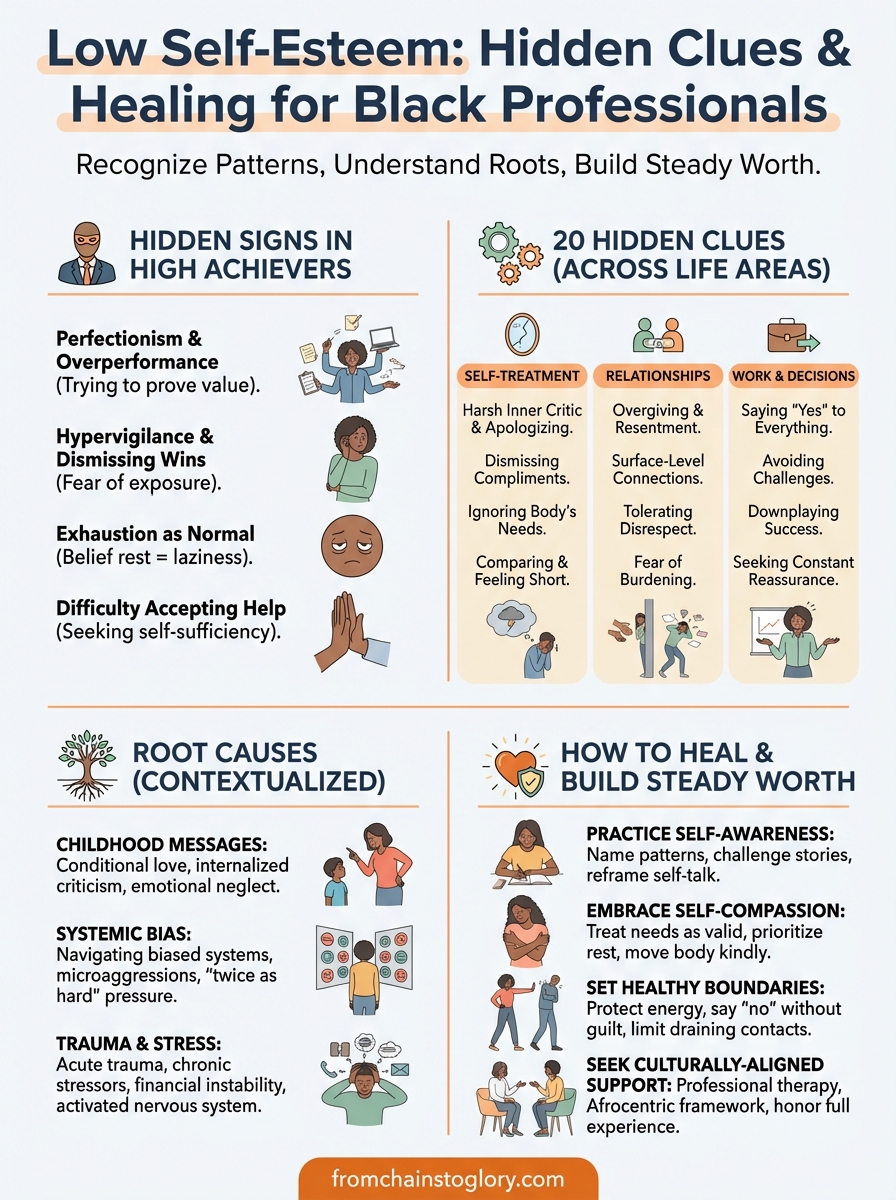
This article breaks down 20 hidden clues that reveal low self-esteem, including the ones that look like success from the outside. You’ll also learn where these patterns come from and practical steps to begin healing. At From Chains to Glory, we understand that reclaiming your sense of worth requires more than generic advice, it requires a framework that honors your full experience.
What low self-esteem looks like and why it matters
Low self-esteem isn’t just about feeling sad or lacking motivation. It shapes how you interpret your experiences, determines which opportunities you pursue, and influences every relationship you build. When your internal sense of worth sits below what you objectively deserve, you make decisions from a place of scarcity rather than abundance. You might overwork to prove your value, avoid challenges where you could fail publicly, or tolerate treatment that someone with steady self-worth would never accept.
The difference between confidence and self-esteem
Confidence relates to your belief in your ability to do something specific, like giving a presentation or closing a deal. You can feel confident in your job skills while still carrying deep doubts about your fundamental worth as a person. Self-esteem runs deeper. It’s your baseline sense of value that exists independent of performance or external validation. This distinction matters because you can build confidence through practice and achievement, but healing self-esteem requires different work.
People often confuse the two because high achievers frequently mask low self-worth with competence. You deliver results, earn promotions, and look successful from the outside. Inside, though, each accomplishment feels temporary, and you’re only as good as your last win. The fear of being exposed as inadequate never quite leaves, no matter how much evidence contradicts it.
Low self-esteem doesn’t always look like someone who’s struggling. Sometimes it looks like someone who’s exhausted from never feeling like enough.
Why it shows up differently in high achievers
When you’ve learned that your safety depends on excellence, low self-esteem often hides behind perfectionism and overperformance. The same patterns that helped you survive and succeed can become the clearest signs of low self esteem working beneath the surface. You say yes to everything, rarely delegate, and believe rest equals laziness. Your standards for yourself sit impossibly high while you extend grace to everyone else.
For Black professionals especially, this dynamic gets tangled with the reality of navigating biased systems. The hypervigilance that protects you from microaggressions can blend with low self-worth until you can’t tell where one ends and the other begins. You might dismiss your achievements as luck or timing, attribute your success to working twice as hard, and struggle to internalize praise because part of you believes you had to earn the right to exist in these spaces.
The cost of carrying low self-worth
Living with unaddressed low self-esteem creates a compound effect over time. Your body stays in a constant state of proving and protecting, which leads to burnout, anxiety, and physical stress symptoms. Relationships suffer because you either avoid vulnerability entirely or give so much that you lose yourself. Career growth stalls not from lack of ability but from the invisible ceiling you’ve placed on what you believe you deserve.
The exhaustion becomes your normal until you forget what peace feels like. You make choices based on minimizing rejection rather than pursuing what you actually want. Your inner voice sounds like a harsh critic who never rests, and you’ve probably started believing that voice tells the truth. This is why recognizing the patterns matters so much. What you don’t name, you can’t change, and these costs only grow heavier the longer they go unaddressed.
20 hidden signs of low self-esteem
These signs of low self esteem often masquerade as personality traits or learned behaviors, especially when you’ve built a life that looks successful on paper. You might recognize yourself in several of these patterns without realizing they point to something deeper than just your temperament or work ethic. The signs below get grouped by where they show up most clearly, though many overlap across different areas of your life.

Signs in how you treat yourself
Your internal dialogue runs harsh and unforgiving, holding you to standards you’d never apply to others. You replay mistakes on a loop but dismiss your wins as flukes or lucky breaks. Physical self-care gets deprioritized because part of you doesn’t feel worth the time or investment. Rest triggers guilt, and you justify downtime only when you’ve earned it through exhaustion.
The patterns include:
- Apologizing constantly, even when you’ve done nothing wrong
- Difficulty accepting compliments without deflecting or minimizing
- Comparing yourself to others and always coming up short
- Perfectionism that keeps you stuck revising instead of completing
- Ignoring your body’s signals for rest, food, or medical attention
You can’t hate yourself into a version of yourself you love. Healing requires changing the voice in your head, not achieving more.
Signs in your relationships
You struggle to believe people genuinely enjoy your company without you performing, helping, or providing something. Vulnerability feels dangerous, so you stay surface-level even with people you trust. You tolerate disrespect or poor treatment because you fear being alone more than being unhappy. Asking for help seems like admitting weakness, and you’d rather struggle silently than burden anyone.
Watch for these relationship patterns:
- Overgiving while rarely receiving, leading to resentment
- Assuming you’re the problem when conflicts arise
- Staying in relationships that drain you because you doubt you deserve better
- Testing people to see if they’ll abandon you
- Feeling like an imposter in social settings despite being welcomed
Signs in your work and decisions
You say yes to everything because disappointing people feels unbearable, even when you’re already stretched thin. Credit goes to your team, luck, or timing, but never to your actual skills and effort. You avoid opportunities where failure is possible, choosing safe paths over growth. Delegation feels impossible because you believe only you can do it right, which really means you fear being seen as inadequate if you need support.
Additional workplace signs include:
- Working excessive hours to prove your worth
- Downplaying your accomplishments in conversations
- Avoiding negotiations for raises or better conditions
- Seeking constant reassurance about your performance
- Taking criticism as confirmation of your deepest fears about yourself
What causes low self-esteem in adults
Low self-esteem rarely appears out of nowhere. It develops through layers of experiences, messages, and survival strategies that accumulate over time. Understanding where these patterns originate helps you recognize that your current struggles aren’t character flaws but logical responses to what you’ve faced. For many Black adults, the causes blend personal history with the ongoing reality of navigating systems built on bias and exclusion.
Childhood experiences that set the foundation
The messages you received about your worth as a child created your baseline. If love felt conditional on performance, grades, or behavior, you learned that your value depends on what you produce. Criticism that focused on who you are rather than what you did taught you to internalize shame. Emotional neglect, even unintentional, signals that your feelings don’t matter, which translates into difficulty trusting your own needs and perspectives as an adult.
Households where survival took priority over emotional connection often produce adults who excel at managing crisis but struggle with self-worth during stability. Parents dealing with their own trauma, financial stress, or discrimination may have had little bandwidth for consistent affirmation. You learned early to make yourself small, helpful, or exceptional to earn the attention and safety you needed.
Systemic and cultural factors
Growing up Black in America means absorbing messages about your worth from systems designed to devalue you. Educational environments that punish your natural expression, workplaces where you face higher standards and lower trust, media that rarely reflects your full humanity, these experiences compound over decades. The exhaustion from proving your competence in every space becomes indistinguishable from the signs of low self esteem that develop in response.
Microaggressions teach you to second-guess your reality. When your experiences get dismissed or minimized repeatedly, you stop trusting your own perception. Code-switching becomes so automatic that you lose touch with which version of yourself feels real, and the constant calculation of safety erodes your sense of inherent value.
You didn’t imagine the ways these systems diminished you. Your self-doubt developed in environments that were designed to create it.
Trauma and ongoing stressors
Acute trauma and chronic stress both reshape how you see yourself. Experiences of violence, loss, or betrayal can shatter your sense of safety and worth, especially when they go unprocessed. Current pressures like financial instability, relationship conflict, or health concerns drain the emotional resources needed to maintain steady self-esteem. Your nervous system stays activated, leaving little space for the reflection and rest that support healing.
For adults carrying both historical and present-day burdens, the accumulated weight makes it difficult to separate temporary struggle from permanent identity. You forget that your worth exists independent of circumstances because those circumstances never seem to ease long enough to remember.
How to heal and build steady self-worth
Healing low self-esteem requires different work than building confidence or achieving more success. You need to address the root beliefs driving those signs of low self esteem rather than just managing the symptoms. This process takes time and won’t follow a straight line, but each small shift in how you treat yourself compounds into lasting change. The strategies below focus on practical actions you can start today, designed specifically for people who’ve spent years putting everyone else first.

Start with self-awareness and truth-telling
You can’t heal what you don’t acknowledge, so begin by naming the patterns without judgment. Notice when you apologize unnecessarily, dismiss compliments, or push through exhaustion. Write down the specific situations where your self-worth drops and what thoughts accompany those moments. This practice helps you see the gap between how you actually perform and how harshly you judge yourself.
Challenge the stories you’ve accepted as truth about your worth. Ask yourself: Would I say this to someone I love? When you catch yourself in harsh self-talk, pause and reframe with the same grace you’d extend to a friend facing similar struggles. Your thoughts aren’t facts, and recognizing this distinction creates space for new patterns to form.
Practice self-compassion in small moments
Self-compassion starts with treating your needs as legitimate, not as inconveniences or weaknesses. This means eating when you’re hungry, resting when you’re tired, and saying no without elaborate justifications. Each time you honor a boundary or need, you send yourself the message that your well-being matters. These small acts accumulate into a stronger foundation of self-worth.
Healing doesn’t require you to become someone different. It requires you to stop abandoning who you already are.
Physical practices help too. Move your body in ways that feel good rather than punitive. Speak to yourself using your name, which creates psychological distance from the harsh inner critic. Create a list of evidence that contradicts your negative self-beliefs and review it when doubt shows up, because your brain needs repetition to rewire old patterns.
Build boundaries that protect your energy
Boundaries aren’t selfish, they’re the structure that allows you to show up fully without depleting yourself. Start with one area where you consistently overextend, then practice saying no or delegating. The discomfort you feel initially signals growth, not wrongdoing. Notice how protecting your time and energy actually improves the quality of what you offer when you do say yes.
Limit exposure to people and situations that consistently diminish you. You can’t build self-worth in environments that actively tear it down. This might mean reducing contact with certain family members, leaving draining friendships, or changing how you engage with social media. Choose relationships and spaces where your full self gets welcomed rather than merely tolerated.
When to get professional support
Self-awareness and personal strategies take you far, but they can’t replace the support of someone trained to help you heal deep patterns. You might notice that despite your best efforts, the signs of low self esteem persist or even intensify under stress. Your relationships still suffer, your nervous system stays activated, or you keep hitting the same walls in different situations. These patterns signal that the work requires more than what you can do alone, and reaching for professional support becomes the next logical step, not a failure.
Signs you’ve outgrown self-help strategies
Your coping mechanisms stop working or start creating new problems. The overwork that used to numb your doubts now pushes you toward burnout. The isolation that felt protective now leaves you completely alone. You recognize the patterns but can’t seem to interrupt them, even with clear intention and effort. Physical symptoms like chronic tension, digestive issues, or sleep disruption persist despite addressing lifestyle factors.
- Difficulty maintaining relationships despite wanting connection
- Anxiety or depression that limits your ability to work or engage
- Using substances, food, or work to avoid feeling
- Suicidal thoughts or self-harm urges, even fleeting ones
You deserve support that meets the depth of what you’re carrying. Asking for help doesn’t erase your strength; it honors it.
What therapy offers that you can’t get alone
Professional support provides the external perspective and specialized tools that self-reflection can’t access. A trained therapist helps you identify blind spots, interrupt patterns in real time, and process experiences your brain might have compartmentalized for survival. The therapeutic relationship itself becomes a place to practice vulnerability, receive consistent validation, and experience repair when conflicts arise.
At From Chains to Glory, you gain cultural alignment from the first session, which eliminates the exhausting work of explaining your reality to someone who doesn’t share your context. The Afrocentric framework integrates your heritage and community values into healing rather than treating them as separate from mental health. Our private-pay model ensures total confidentiality without diagnoses attached to insurance records, and the 90-Day Success Map provides structure that moves you from exhaustion to steady peace. You can schedule a consultation to explore whether this approach fits your specific needs and goals.
Next steps
Recognizing the signs of low self esteem in your own life takes courage, and reading this far shows you’re ready to stop accepting exhaustion as normal. You’ve spent enough time proving your worth to everyone else while quietly questioning it yourself. The patterns you identified here developed over years, and healing them requires consistent practice paired with the right support structure.
Start with one small boundary or one moment of self-compassion this week. Notice when you apologize unnecessarily, then stop mid-sentence and choose different words. Track situations where you dismiss your accomplishments and write down the objective facts instead. These micro-practices build the foundation for lasting change.